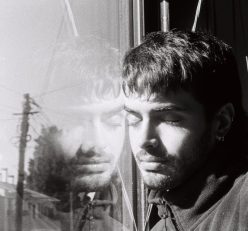
Lucia explains through a reel her first experience in the UK, Winchester. She didn’t speak English, and as she mentions, she had a culture shock. I was not particularly eager to go to the pub after uni, and I couldn’t communicate very well, so I would sit in a corner. People started saying that I had different personalities depending on the language I was speaking. She became interested in the gap between communication (languages) and how people get caught in that situation. She started with video art. With video, Lucia could see her behavioural response depending on the language she was speaking. In one of her video art pieces, she noticed that the sound would change a lot by speeding up and down the velocity of the image.
Lucia started researching sound arts and came across Jacob Kirkegaard’s 4 Rooms piece (Touch Records 2006). In this work, the artist goes to Chernobyl and records the room tones who four different interior spaces. She was fascinated by how it was possible to do recordings that way, which recalls Alvin Lucier’s I’m sitting in a Room (1969). Her first sound art piece came in 2009: Spring Piece, Listening by placing your ear on the window. It’s also about her experience in the UK back when she lived in Kings Cross. By that time, she lived in a place that she describes as being awful and decadent. Her window wasn’t double glazed and made a lot of noise whenever a bus passed by. She decided to use the same techniques that Jacob used in his piece. I was trying to work out how to record sound. I’m not musically trained, and I’ve zero knowledge of recording techniques. She kept interested in looping things as a visual and sonic experience. With “2 pm”, I wanted to enhance this idea. ‘Folding’ (2009) is another piece where she experiments with the phenomena, and by “folding”, she meant folding time. Hear One Near and Think of the Other was her last piece before she ended her PhD. It’s a 2-channel durational live performance that took place in 2011. Lucia wanted to invite the listener to walk through different areas. Two performers set it, and they would be playing samples live. In 2011 she played live signal feedback on a piece called Parallel Correlation.

She commented on her experience playing live digitally and in person. She reflects how signal feedback changes when it’s mixed remotely and through speakers into a designed space. Toshimaru Nakamura and Sachiko M. are two artists that reflect on the same topics in a video called No-input: “it’s like a sculpture.”. In 2016 she attempted for the first time No-input feedback in a piece called Inner Geography. I normally use broken mixers because they sound better and have more interesting sounds. Currently, Lucia keeps doing live performances with no inputs. In 2020, she performed Courier Despatch 3 00. In the same here, she performed with Steph Horak and Iris Garrels in an improv session called TRIO (SOLO: DUO: TRIO). I met them the same day we performed at CAFE OTO.